La consommation de drogues, d’alcool et de tabac et la participation aux jeux de hasard et d’argent sont en diminution chez les jeunes du secondaire au Québec. Cependant, de nouveaux enjeux de santé publique se dessinent : le vapotage et le temps passé devant les écrans. Avis de révision : Des données et du texte ont été modifiés aux pages 48 et 74 du rapport statistique.
The showcase features indicators related to demographics, material living conditions, work, retirement, lifestyle, health and well-being, and the social participation of seniors. Update: Pratique du bénévolat; Heures consacrées au bénévolat.
Data on population projections according to the municipalities geographical level, from up to 2051.
Data on projections about the number of private households and number of persons in collective housing according to RCMs geographical level, through 2051.
Data on the evolution of the Québec population and its age and gender structure, as well as on the components of demographic growth. Some comparisons are made with Canada and the other provinces.
Short highlights and data are presented in the form of graphs to provide a better understanding of the situation of young people in Québec. Update: Population âgée de 15 à 29 ans.
Data on population projections in Québec up to 2071.
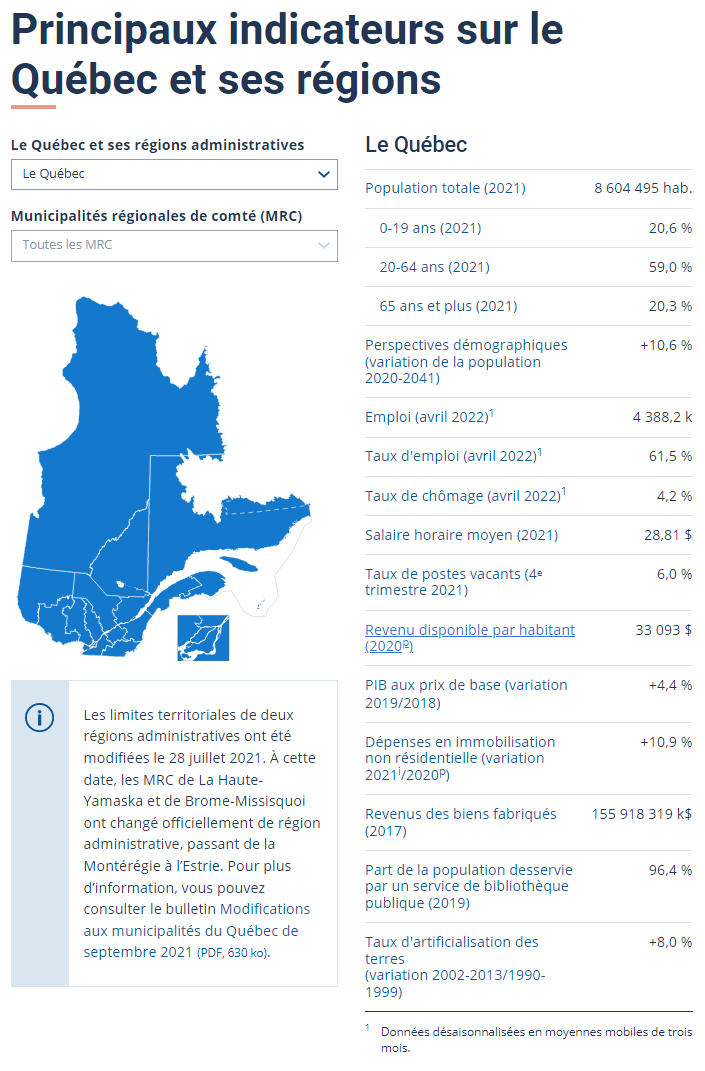
Economic, demographic, cultural and environmental indicators for all of Québec, its administrative regions and their RCMs. Latest update: Job vacancy rate.
Main results presented in a summary dashboard. Detailed information is also provided for each indicator. Update: Écart de diplomation selon le milieu socio-économique.
Avis de modification : Données corrigées et ajout de nouvelles données.