
Governance rules
The amendments made to the Act respecting the Institut de la statistique du Québec in the spring of 2021 have imposed new requirements on the Institut de la statistique du Québec (ISQ). The ISQ is now required to set rules for the governance of designated information that can be communicated to researchers. These rules govern the protection, retention, and destruction of this information and define the roles and responsibilities of ISQ staff members throughout the life cycle of this information.
On August 7, 2023, the Commission d’accès à l’information approved the ISQ’s Règles de gouvernance concernant les renseignements désignés par le gouvernement et communiqués à des fins de recherche aux chercheurs liés à un organisme public (Governance rules for government-designated information communicated for research purposes to researchers attached to a public body). These rules will be updated and re-approved by the Commission every three years.
In accordance with its founding legislation, the ISQ is making these governance rules (PDF, 2.54 MB; in French only).
Protection of personal information and confidentiality
The ISQ has expertise in access to data and the protection of personal information. It makes sure that any identifying information is removed from the data provided to researchers.
The ISQ provides access to research files within a highly secure environment, either on the premises of its Data Access Centres (CADRISQ) or via secure remote access. Access is only provided to authorized individuals who have signed a confidentiality agreement. Files that are accessible remotely are different from those available at CADRISQ centres, as some information may be modified for remote access to meet the ISQ’s privacy obligations.
The ISQ reviews all results produced based on research data before they are published in order to prevent the disclosure of confidential information.
Legislative context
Act respecting the Institut de la statistique du Québec
The Act respecting the Institut de la statistique du Québec gives the ISQ a mission regarding access to data for research purposes and sets out the terms for the request, communication, use, and destruction of designated information that comes from public bodies (chapters I, I.1, I.2, III.1 and III.2).
Act respecting Access to documents held by public bodies and the Protection of personal information
The ISQ is also required to comply with the Act respecting Access to documents held by public bodies and the Protection of personal information, which compels ministries and agencies to protect the confidentiality of identifying information.
Act respecting health and social services information
The Act respecting health and social services information provides a framework for the use of data from the health and social services network for research purposes according to the type of researcher carrying out the research project in question.
Researchers in the health network who want to use designated information (apart from health or social services information) within the meaning of the Act respecting the Institut de la statistique du Québec (e.g. data held by the Ministère de l’Éducation or Revenu Québec) must address a request to the ISQ.
Researchers attached to a public body who are not in or attached to the health and social services network must submit a request to the ISQ to be able to access designated information under the Act respecting the Institut de la statistique du Québec.
Accountability
Processing times for access requests
Project classification criteria
Research projects fall into one of four complexity categories. A project’s complexity level is essentially based on the nature of the research files to be produced and the quality of the databases required.
Nature of the files: administrative data or ISQ survey data; common unique identifier; one or two cohorts totalling fewer than 50,000 individuals; research period shorter than 10 years.
Nature and quality of the source databases: optimal (homogenous, structured, duplication-free databases; available, validated documentation).
Nature of the files: administrative data, ISQ survey data, data collected by the researcher; common unique identifier; one to four cohorts totalling fewer than 100,000 individuals; research period shorter than 15 years.
Nature and quality of the source databases: varying.
Nature of the files: administrative data, ISQ survey data, data collected by the researcher; no common unique identifier; large number of individuals; long research periods; large number of research files requested; links to non-designated information, specific elements (e.g., identifying family relationships).
Nature and quality of the source databases: varying.
Situation report - September 30, 2026
Since January 2023, 565 requests have been submitted through the Research Zone of the ISQ’s Research Data Access Services. These requests include preliminary analysis requests, requests for access to research files, change requests, extension requests, and requests for secondary use of data.
Since January 2023, research teams working on 176 projects had obtained access to research files in CADRISQ centres or remotely.
On average, research teams obtain access to the desired research data in 148 days (4.9 months). The median is 118 days. For simple projects, access is obtained in an average of 112 days (3.7 months), while for complex projects, access is obtained in an average of 304 days (10 months). These timeframes include the time required for the ISQ to process requests, as well as the time required for researchers, data-holding organizations, and organizations responsible for authorizations to respond and transmit the necessary documents.
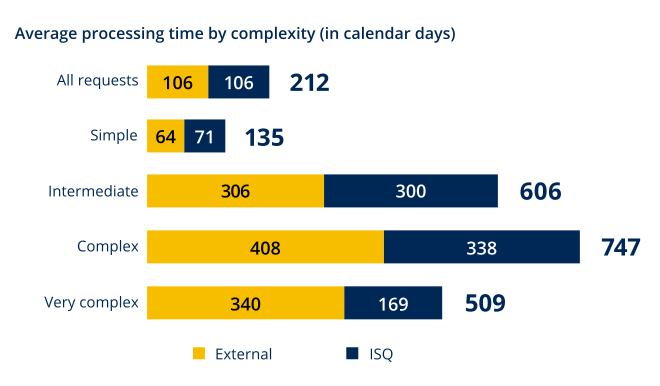
All requests: 50 external days, 90 ISQ days, 140 in total.
Simple : 36 external days, 68 ISQ days, 104 in total.
Intermediate : 84 external days, 152 ISQ days, 236 in total.
Complex: 119 external days, 179 ISQ days, 298 in total.
Note
External time means the time attributable to researchers (to respond to analysts’ requests for clarifications, to send mandatory documents, etc.) or to government bodies (data-holding ministries and agencies, Commission d’accès à l’information, etc.).