
Québec, November 4, 2020. – According to intentions for 2020, non-residential tangible capital expenditure should total $41.7 billion in Québec, down 3.7% from 2019 ($43.3 billion). These results come from Statistics Canada’s Annual Capital and Repair Expenditures Survey released on August 11, 2020.
The regional distribution of the results carried out by the Institut de la statistique du Québec based on various sources of information shows that for 12 out of 17 regions in Québec, capital expenditures for 2020 should be lower than in 2019. These are some of the main findings of Investissements privés et publics, Québec et ses régions released today by the Institut.
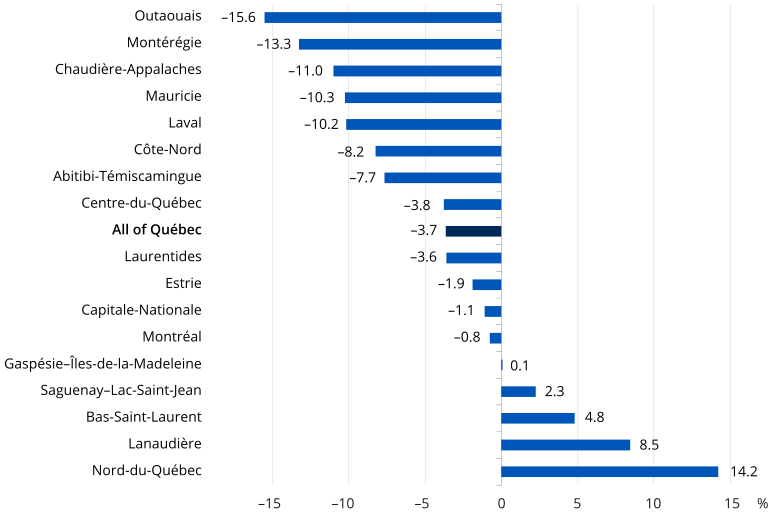
2020 intentions for non-residential tangible capital expenditures, Annual change, all of Québec and administrative regions
Sources: Institut de la statistique du Québec, Statistics Canada, Ministère des Affaires municipales et de l’Habitation, Commission de la construction du Québec, Fisheries and Oceans Canada, and Ministère de la Santé et des Services sociaux. Adapted by the Institut de la statistique du Québec.
Sharp declines observed in several regions
In the administrative regions of Outaouais, Montérégie, Chaudière-Appalaches, Mauricie and Laval, intentions regarding non-residential tangible capital expenditures for 2020 have dropped more than 10%.
In particular, after five years of increase, the administrative region of Montérégie should register a 13.3% decline. This decline in non-residential tangible capital expenditures should be concentrated mainly in the goods-producing industries and the federal public administration sector.
Growth in five administrative regions
Despite a negative overall picture, capital expenditures in 2020 should be up in the regions of Nord-du-Québec (14.2%), Lanaudière (8.5%), Bas-Saint-Laurent (4.8%), Saguenay–Lac-Saint-Jean (2.3%) and Gaspésie–Îles-de-la-Madeleine (0.1%). These increases should mainly be due to the mining, quarrying, and oil and gas extraction sector for Nord-du-Québec; transportation and warehousing, educational services, and local, municipal and regional public administration for Lanaudière; information and cultural industries for Bas-Saint-Laurent; and local, municipal and regional public administration for Saguenay–Lac-Saint-Jean.
Foreign investment down
In Québec, majority foreign-controlled enterprises are expected to spend nearly $3.9 billion in private, non-residential tangible capital expenditures in 2020, a 12.8% drop from 2019. The expenditure forecast for Canadian-controlled private enterprises (including those in Québec) is $15.5 billion in 2020, down 8.9%.
All administrative regions should see a decline in foreign-controlled capital expenditures, except for Côte-Nord and Abitibi-Témiscamingue.
Data for all of Québec, administrative regions and CMAs are available online
Data on capital and repair expenditures (by industry, according to private or public ownership and country or province of control) as well as on residential construction expenditures and selected intellectual property product expenditures for the 2006–2020 period are available under Statistics, subject Investments.
The Institut de la statistique du Québec produces, analyzes and disseminates official, objective and quality statistical information on various aspects of Québec society. It is responsible for carrying out all statistical surveys of general interest. The relevance of its work makes it a strategic ally for decision makers and all those wishing to learn more about Québec.