
Québec, July 23, 2020. – In 2016, nearly 3 out of 10 Quebecers had a university certificate, diploma or degree. Women are more likely than men to achieve university-level education (33% vs. 26%) or college-level education (21% vs. 17%). Men, on the other hand, are proportionally more likely to have completed vocational training. These results, published today in the Bulletin sociodémographique of the Institut de la statistique du Québec, are drawn from the 2016 Canadian Census on the education levels and fields of study of the Québec population aged 25 to 64.
Distribution of population aged 25 to 64 by sex and highest certificate, diploma or degree obtained, Québec, 2016
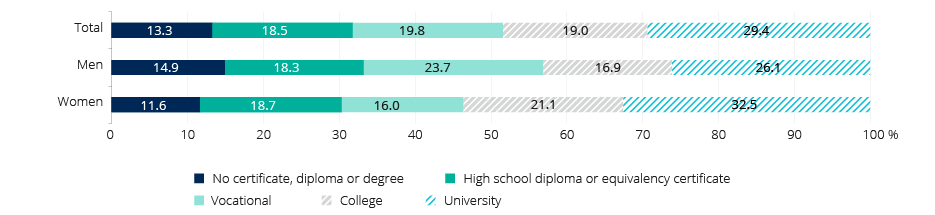
Source: Statistics Canada, 2016 Census. Adapted by the Institut de la statistique du Québec.
Improvement in the education level of both sexes, particularly among young women
Compared to the population aged 55 to 64, the population aged 25 to 34 has a higher proportion of people with a vocational, college or university certificate, diploma or degree. Compared to their elders, the share of men aged 25 to 34 with a university degree is almost 7 percentage points higher, while the share of young women has jumped more than 20 percentage points.
Distribution of population aged 25 to 34 and 55 to 64 by sex and highest certificate, diploma or degree obtained, Québec, 2016

Source: Statistics Canada, 2016 Census. Adapted by the Institut de la statistique du Québec.
Distribution of men and women by field of study remains contrasted
The largest differences are found in architecture, engineering and related services (much more prevalent among men), health and related fields, and business, management and public administration (more prevalent among women).
The distribution of 25-34 year-olds by field of study is similar to that of their elders, with some differences for women. There is a higher proportion of young women in social and behavioural sciences and law, as well as in architecture, engineering and related services.
Distribution of population aged 25 to 64 with a post-secondary certificate, diploma or degree, by main field of study and sex, Québec, 2016
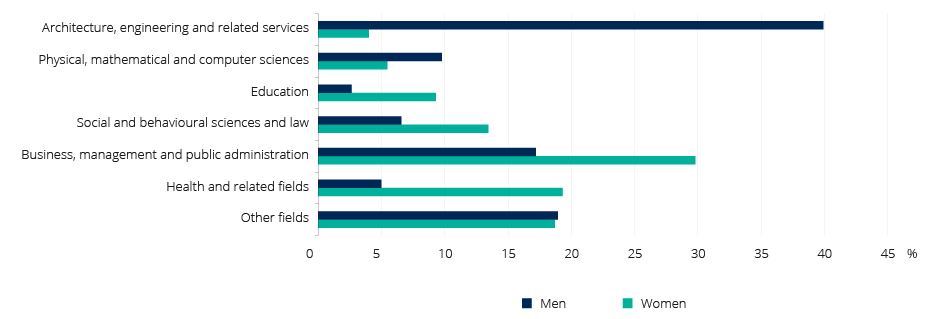
Source: Statistics Canada, 2016 Census. Adapted by the Institut de la statistique du Québec.
Quick links
- Graduation and educational level: 2016 Census tables
The Institut de la statistique du Québec produces, analyzes and disseminates official, objective and quality statistical information on various aspects of Québec society. It is responsible for conducting all statistical surveys of general interest. The relevance of its work makes it a strategic ally for decision makers and all those wishing to learn more about Québec.