
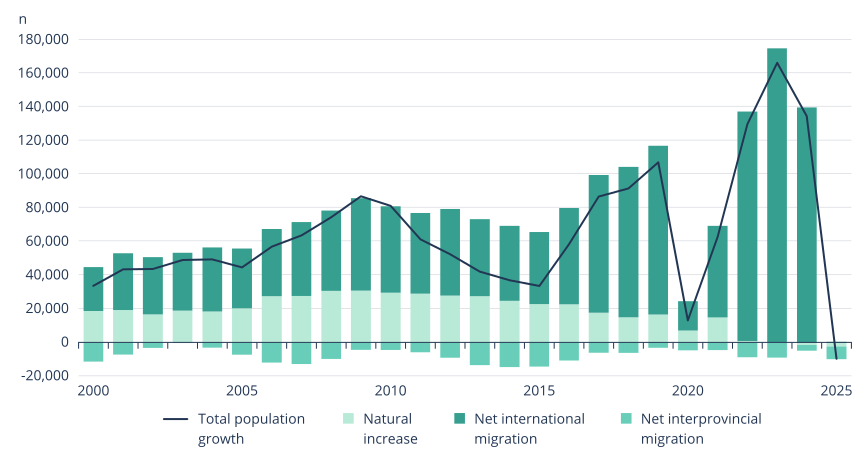
Québec, May 13, 2026. – Québec’s population was estimated at 9.03 million people on January 1, 2026. According to preliminary data, after exceptionally strong growth from 2022 to 2024, the population decreased slightly by
-9,600 people (-0.1%) in 2025.
Deaths exceeded births for the second consecutive year in 2025. In a rare occurrence, international migration generated virtually no growth: permanent immigration was up slightly, but temporary immigration declined after hitting unprecedented levels in the three previous years.
These findings come from the publication Bilan démographique du Québec released today by the Institut de la statistique du Québec.
Total population growth, natural increase and migration increase, Québec, 2000–2025
Note
Natural increase is the difference between the number of births and deaths. Net international migration is the sum of permanent and temporary immigrants, minus emigrants. Net interprovincial migration is the difference between in-migrants from and out-migrants to the rest of Canada.
Sources
Statistics Canada and Institut de la statistique du Québec.
Fertility rate remains among the lowest on record in Québec
In 2025, 78,200 babies were born in Québec, 800 more than in 2024 (+1%). The fertility rate is estimated at 1.36 children per woman, up slightly from the historic low of 1.35 in 2024. Nevertheless, the fertility rate remains one of the lowest on record in Québec and is part of a general downward trend observed over the past 15 years.
The tendency for women to have their children later continues. In 2025, the average age of mothers at the birth of a first child reached 30.2 years.
Within Canada, fertility remains higher in Québec than in most of the other provinces.
Overall mortality impacted by two influenza episodes
In 2025, 80,450 deaths were recorded in Québec, up 1,650 from 2024 (+2.1%). While the number of deaths is expected to increase in the context of population aging, an analysis of the excess mortality reveals that this number was 4% higher than anticipated based on pre-pandemic trends. This is mainly due to two episodes of excess flu-related mortality, which led to spikes in deaths in late February and late December.
In this context, life expectancy stood at 84.4 years for women and 81.1 years for men, which is comparable to the average figures observed since 2016. Despite some stagnation, life expectancy in Québec remains among the highest in the world and exceeds that in the rest of Canada.
A year marked by low international migration gains
Québec’s total net migration, which includes international and interprovincial migration, is estimated at -7,150 people in 2025, according to the first data available. Contrary to what is usually observed, international migration barely generated any gains (450 people) in the past year and therefore was not sufficient to offset migration losses to other provinces (-7,600 people).
Québec welcomed 60,150 new immigrants as permanent residents in 2025, slightly more than in 2024 (59,400). However, the number of non-permanent residents (or temporary immigrants) present in Québec decreased after rising sharply from 2022 to 2024. Their number is tentatively estimated at 514,050 on January 1, 2026, down 51,400 from 565,450 a year earlier. Temporary immigration was also down in the rest of Canada.
Stay updated on new data
Population data are updated regularly on the ISQ’s website as new information becomes available. These updates may lead to results being revised, particularly regarding temporary immigration.
The Institut de la statistique du Québec is the public body responsible for providing reliable, objective statistical information about Québec society. The relevance of its work makes it a strategic ally for decision makers and an essential source of information for all those wishing to learn more about Québec.