
Québec, December 10, 2019. – In 2018, Québec’s population grew by 87,000 people, standing at 8.43 million people on January 1, 2019. The preliminary data for the first six months of 2019 showed accelerated population growth, bringing Québec’s population to 8.48 million on July 1, 2019.
The growth rate of the Québec population remained below the Canadian average, causing Québec’s demographic weight in Canada to drop slightly. It stood at 22.6% on July 1, 2019. These findings come from the 2019 edition of the Bilan démographique du Québec published today by the Institut de la statistique du Québec.
Births and deaths
In 2018, the number of births was estimated at 83,800, a number similar to that of 2017 (83,855). The total fertility rate stood at 1.59 children per woman, compared to 1.60 in 2017. This rate has been declining since the recent high of 1.73 children per woman in 2008 and 2009.
As for the number of deaths, it was estimated at 68,600 in 2018, up 2,300 from 2017. This increase is part of a general upward trend in the number of deaths caused by an aging population. Life expectancy in 2018 was 80.7 years for men and 84.2 years for women. These levels are similar to those registered in 2017 and 2016.
International and interprovincial migration
In 2018, the population growth from international net migration was close to 43,000 people in Québec, which resulted from 51,100 newly admitted international immigrants and approximately 8,300 emigrants who left the country. This represents a slight decline from 2017 (44,300 people).
Québec welcomed 15.9% of newcomers to Canada in 2018, a share that is lower than its demographic weight (22.6%). The most common countries of birth of immigrants admitted in Québec in 2018 were China (10.4%), France (7.7%), India (7.5%), Syria (5.7%) and Algeria (5.4%).
Québec’s net interprovincial migration with the rest of Canada was estimated at -5,800 people in 2018. This migration deficit is similar to the one recorded in 2017 (-6,000), but less important than in 2016 (-10,600 people) and from 2013 to 2015 (-14,000 on average).
Non-permanent residents increased by 34,700 in 2018, exceeding the previous record set in 2017 (30,000). On July 1, 2019, temporary workers accounted for half of all non-permanent residents. The share of foreign students was 26% and that of asylum seekers 23%.
Net total, international and interprovincial migration, and net non-permanent residents (NPR), Québec, 1986-2018
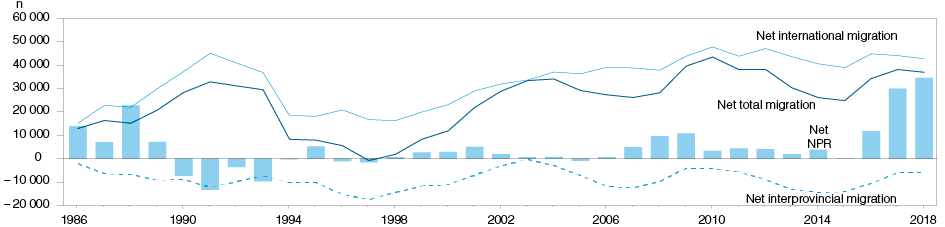
Notes and sources: Net total migration is the sum of net international migration (immigrants minus emigrants) and net interprovincial migration (in-migrants minus out-migrants). Net non-permanent residents (NPR) is counted separately. Statistics Canada, Population estimates (September 2019). Adapted by the Institut de la statistique du Québec.
Population structure
In July 2019, 21% of the Québec population was under the age of 20, 60% was 20 to 64 years of age, and 19% was 65 or over. The share of 20–64 year-olds in the total population is decreasing, while the share of people aged 65 or over continues to increase. The female population was slightly older than the male population, with average ages of 43.3 and 41.6, respectively.
Marriages
In 2018, the number of marriages was estimated at 22,800, which is almost as much as in 2017 (22,883). According to preliminary data, same-sex marriages accounted for 3% of all marriages. Still, the propensity of Quebecers to get married remains low. According to current nuptiality conditions, only 28% of men and 31% of women are expected to marry at least once before their 50th birthday.
Chronological series, international comparisons and regional reports
The 2019 edition of the Bilan démographique du Québec presents a number of analyses, chronological series, and comparisons with Canada and a few other countries. Regional factsheets provide an overview of the demographic situation in each of Québec’s 17 administrative regions.
The Institut de la statistique du Québec produces, analyzes and disseminates official, objective and quality statistical information on various aspects of Québec society. It is responsible for conducting all statistical surveys of general interest. The relevance of its work makes it a strategic ally for decision makers and all those wishing to learn more about Québec.