
Québec, July 13, 2020. – In 2019, almost all (99.8 %) Québec businesses were SMEs, i.e. businesses with fewer than 500 employees, and more than half (53.0 %) had fewer than 5 employees. The latter group contributed the most to business and employment dynamics. This was revealed in the bulletin Science, technologie et innovation released today by the Institut de la statistique du Québec.
Higher share of businesses with fewer than 5 employees in Ontario than in Québec
In Québec, business locations with 100 to 499 employees represent only 1.8 % of the business population, those with 20 to 99 employees, 12.4 %, and those with 5 to 19 employees, 32.6 %.
The proportion of SMEs in Ontario is similar (99.7 %) to that in Québec, but its distribution by workforce size is slightly different. For example, Ontario has a higher proportion than Québec of locations with 1 to 4 employees (58.4 %), but a lower proportion of locations with 5 to 19 employees (28.8 %) and 20 to 99 employees (10.7 %).
Distribution of business locations with employees by workforce size, Québec, Ontario and Canada, December 2019
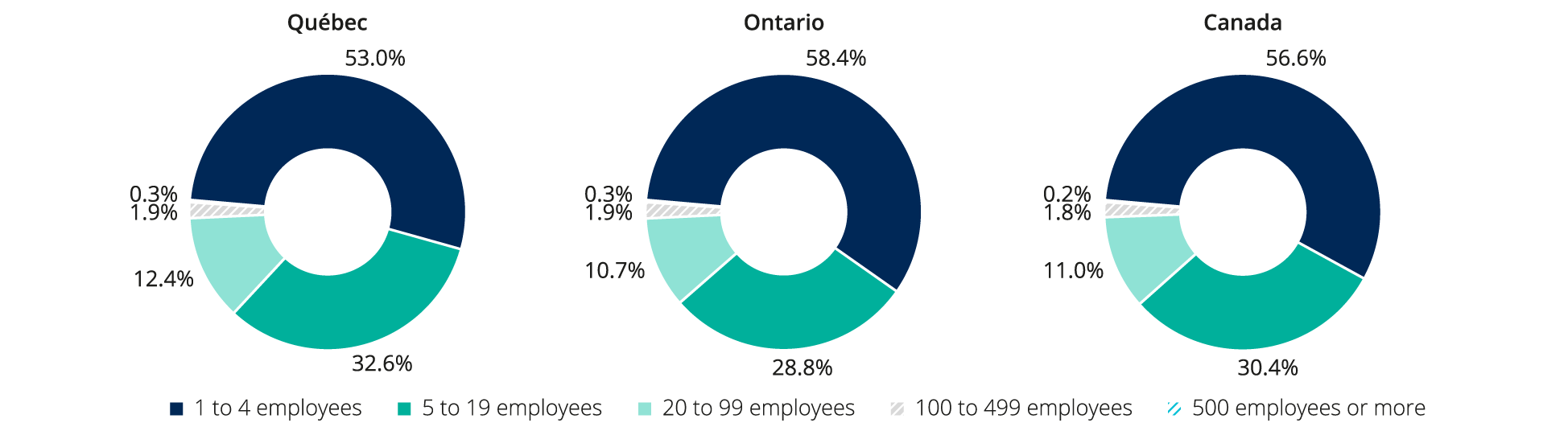
Source: Statistics Canada, Table 33-10-0222-01 – Canadian Business Counts, with employees, December 2019. Adapted by the Institut de la statistique du Québec.
Businesses with fewer than 5 employees are concentrated in four industries
More than half (52.8 %) of Québec SMEs are found in five industries with relatively low productivity levels, including four service-producing industries (retail trade; professional, scientific and technical services; health care and social assistance; and accommodation and food services) and one goods-producing industry (construction).
In comparison, almost half (47.4 %) of businesses with 1 to 4 employees are found in four of these industries, excluding accommodation and food services.
Businesses with fewer than 5 employees contribute the most to renewal of business population and employment
In 2017, 95.1 % of entering businesses and 95.5 % of exiting businesses in Québec had fewer than 5 employees, proportions similar to those recorded over the last five years.
Entering or exiting businesses with 100 to 499 employees were rather rare (representing barely 0.1 % of the total).
In addition, Québec businesses with fewer than 5 employees contributed to 20.3 % of gross employment growth and 22.1 % of gross employment deletion in 2017.
In contrast, businesses with 100 to 499 employees contributed to 18.1 % of gross employment growth and 14.2 % of gross employment deletion, proportions below their share of total employment (20.6 %).
Succession and average age of businesses with fewer than 5 employees
In 2017, Québec companies with 1 to 4 employees averaged an estimated age of 15.3 years. This figure is close to the average age of all SMEs (17.0 years), but is clearly below that of businesses with 100 to 499 employees (22.0 years).
It is estimated that between 2018 and 2022, businesses with 1 to 4 employees (30.7 %) will be more subject to sale, transfer or closure than those with 100 to 499 employees (18.6 %).
Barriers to growth for businesses with fewer than 5 employees
In 2017, businesses with 1 to 4 employees identified three barriers to growth:
- the corporate tax rate (39.4 %);
- increased competition (39.3 %);
- higher input costs (31.3 %).
In contrast, businesses with 100 to 499 employees reported only one of these three barriers to growth: increased competition (73.3 %). Labour shortages (69.1 %) and recruitment and retention of skilled workers (63.6 %) were two other obstacles they reported encountering.
The Institut de la statistique du Québec produces, analyzes and disseminates official, objective and quality statistical information on various aspects of Québec society. It is responsible for conducting all statistical surveys of general interest. The relevance of its work makes it a strategic ally for decision makers and all those wishing to learn more about Québec.