
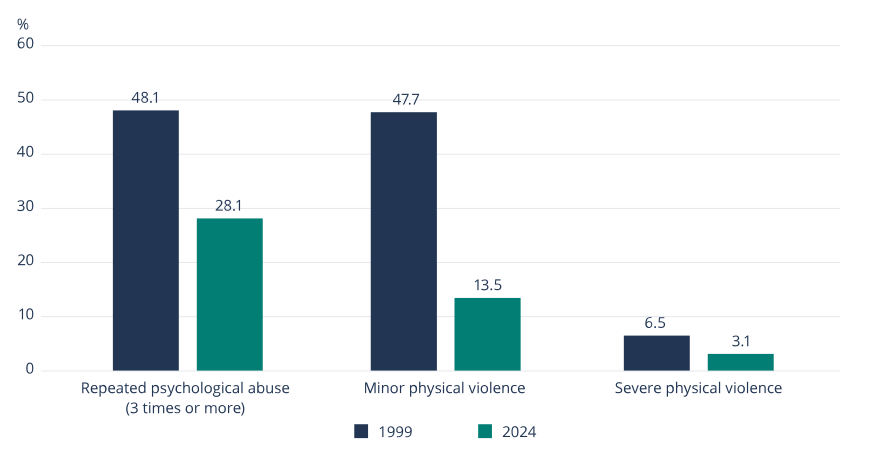
Québec, October 21, 2025. – Between 1999 and 2024, on an annual basis, repeated psychological abuse against children in a family context (yelling at the child, insulting or threatening to spank them, etc.) decreased from 48% to 28% in Québec. Minor physical violence (slapping the child’s hand, pinching or spanking the child, etc.) dropped from 48% to 13%, while severe physical violence (punching or kicking the child, grabbing them around the neck, hitting them with an object, etc.) went from 7% to 3.1%.
Violence against children, children aged 6 months to 17 years, Québec, 1999 and 2024
Source
Institut de la statistique du Québec, Survey on Family Violence and Neglect in the Lives of Québec Children, 1999 and 2024.
Violence towards children has decreased significantly in Québec over the past 25 years, but it nevertheless remains present today. In 2024, it is estimated that:
- 454,180 children experienced repeated psychological abuse
- 217,490 children experienced minor physical violence
- 50,660 children were victims of severe physical violence
These findings come from the 2024 edition of theSurvey on Family Violence and Neglect in the Lives of Québec Children carried out over the past 25 years by the Institut de la statistique du Québec on behalf of the Ministère de la Santé et des Services sociaux. It was conducted among 6,248 parents of children aged 6 months to 17 years. This survey is unique in the world and stands out because of its scope and recurrence.
Fewer parents in favour of corporal punishment than before
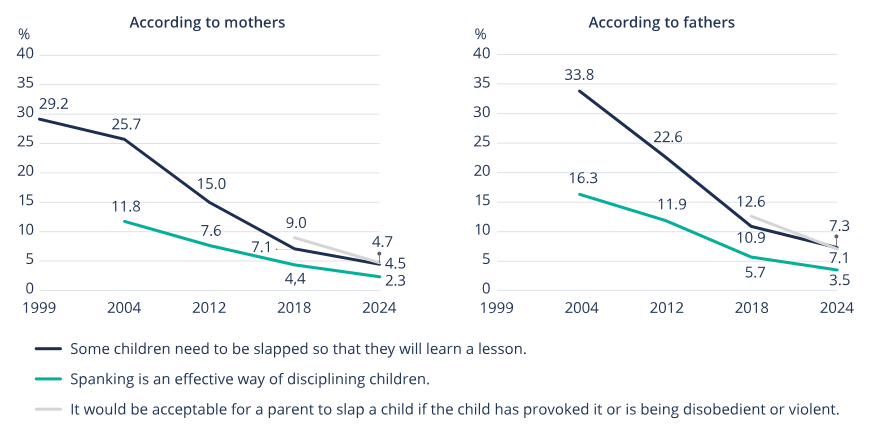
The proportion of parents in favour of corporal punishment declined significantly between 1999 and 2024 among both mothers and fathers.
Parental attitudes towards corporal punishment, parents of children aged 6 months to 17 years, Québec, 1999 to 2024
Source
Institut de la statistique du Québec, Survey on Family Violence and Neglect in the Lives of Québec Children, 1999, 2004, 2012, 2018, and 2024.
Nearly 1 in 10 children in Québec are considered neglected
Child neglect in a family context refers to an inadequate response to children’s needs that puts their well-being or development at risk. The proportion of children considered to be neglected stood at 8% in Québec in 2024 (about 122,400 children).
- Cognitive or emotional neglect: 1.7% of children (about 26,630 children)
- Supervision neglect: 6% of children (about 100,260 children)
- Physical neglect: 0.6% of children (about 10,430 children)
About 14% of teenagers are subject to supervision neglect, compared to 4.3% of children aged 6 months to 5 years and 2.1% of children aged 6 to 12.
Some children are exposed to intimate partner violence, sometimes before birth
In 2024, approximately 20% of children—about 323,880 children—were exposed to physical or psychological violence between intimate partners in the 12 months before the survey.
Children’s rate of exposure to intimate partner violence is lower for physical violence (2.5%) than for psychological violence (19%).
Looking at the perinatal period, the biological mother of 12% of children aged 6 months to 5 years reported having experienced this type of violence between the start of the pregnancy and the child’s second birthday, which represents 56,330 children in this age group.
To lear more:
- Read the highlights (in French only)
- Read the full report (PDF) (in French only)
The Institut de la statistique du Québec produces, analyzes and disseminates official, objective and quality statistical information on various aspects of Québec society. It is responsible for conducting all statistical surveys of general interest. The relevance of its work makes it a strategic ally for decision makers and an essential source of information for all those wishing to learn more about Québec.