
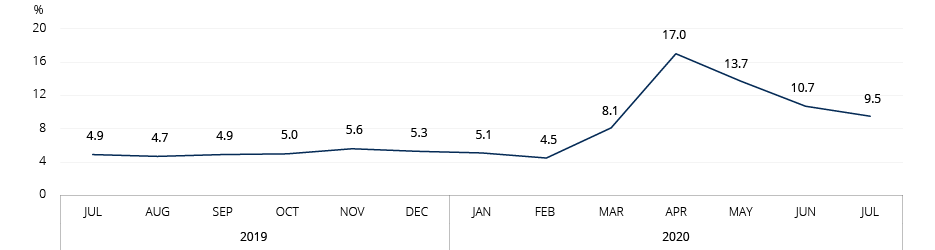
Montréal, August 7, 2020. – Québec recorded an increase of 97,600 jobs (+2.4%) in July 2020 compared to June 2020. The unemployment rate decreased by 1.2 percentage points in July to 9.5%. These are the main highlights of the employment and labour force data based on the results of Statistics Canada’s Labour Force Survey released today.
In the last three months, employment increased by 576,000, which represents more than two-thirds (70%) of the 820,500 jobs lost between February and April 2020. The employment level in July is similar to the level in March, when containment measures began.
In July, full-time employment remained stable while part-time employment increased by 98,300. Employment increased in the private sector (+53,700), the public sector (+28,600) and among the self-employed (+15,400). The participation rate rose 0.7 percentage points to 64.3% and the employment rate increased by 1.3 percentage points to 58.1%.
In Canada, employment in July rose by 418,500 (+2.4%). The unemployment rate fell 1.4 percentage points to 10.9%. Québec, Ontario (+150,700), British Columbia (+70,200) and Alberta (+67,300) posted the largest employment gains.
In the first seven months of 2020, compared to the same period of the previous year, employment in Québec fell by 267,100. During this period, full-time employment fell by 130,700 and part-time employment by 136,400. Since the beginning of 2020, the unemployment rate in Québec has averaged 9.7% (9.8% in Canada).
Word of caution regarding the effects of COVID-19 on LFS data
As in March, April, May and June, the effects of the COVID-19 crisis on the labour market in July should be interpreted with caution when analyzing Labour Force Survey (LFS) data.
The survey reference period for July extends from July 12 to 18. Therefore, the effects on employment and unemployment of certain measures taken by the Québec government during this period were potentially measured by the survey, notably the reopening of restaurants in the Greater Montréal area, the resumption of indoor sports activities and the deconfinement of all sectors (except for festivals and large gatherings, summer camps with stays, and combat sports). Given that returning to work in offices has been permitted since July 18 (the last day of the reference week) its impact is partly measured in this edition of the LFS.
The correct categorization of a person’s labour force status according to the usual definitions of employment, unemployment1 and inactivity may have been more difficult in this edition of the survey.
In addition, the gradual phase-out of containment measures at different rates from one province to another may affect interprovincial comparisons.
A longer analysis period is necessary to assess the trend effects of the COVID-19 pandemic on the Québec labour market. It should also be noted that the monthly data are based on a sample and are therefore subject to a certain amount of variability. Statistics Canada’s The Daily provides detailed analyses of the pandemic’s impact on the labour market in July 2020.
The LFS estimates for administrative regions, seasonally adjusted by the Institut de la statistique du Québec, are published as three-month moving averages to smooth out irregular fluctuations due to small sample sizes. For more information on the interpretation of these data, please refer to Quelques rappels concernant les moyennes mobiles sur trois mois (MM3M) (in French only).
_________
1 The Labour Force Survey defines unemployed persons as those who, during the reference week : 1- were on temporary layoff with an expectation of recall and were available for work; or 2- were without work, had looked for work in the past four weeks, and were available for work; or 3- had a new job to start within four weeks, and were available for work.
Changes in employment and trend-cycle data, Québec, July 2019 to July 2020
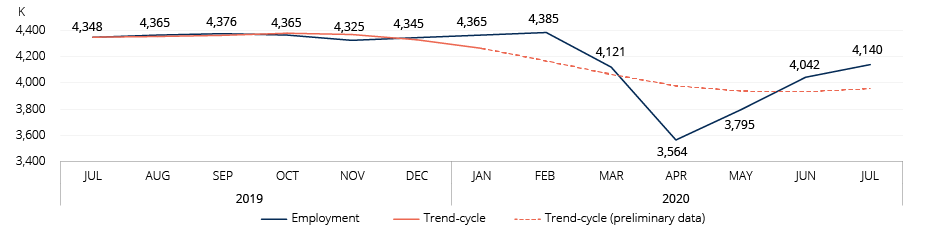
Note: Trend-cycle data are a smoothed version of seasonally adjusted data where the effects of irregular movements have been reduced. They are helpful in analyzing long-term changes in the data. For more information: Statistics Canada, Trend-cycle estimates – Frequently asked questions.
Source: Statistics Canada, Labour Force Survey, 2020. Adapted by the Institut de la statistique du Québec.
Changes in the unemployment rate, Québec, July 2019 to July 2020
Source: Statistics Canada, Labour Force Survey, 2020. Adapted by the Institut de la statistique du Québec.
The Institut de la statistique du Québec produces, analyzes and disseminates official, objective and quality statistical information on various aspects of Québec society. It is responsible for conducting all statistical surveys of general interest. The relevance of its work makes it a strategic ally for decision makers and all those wishing to learn more about Québec.
The Institut de la statistique du Québec produces, analyzes and disseminates official, objective and quality statistical information on various aspects of Québec society. It is responsible for conducting all statistical surveys of general interest. The relevance of its work makes it a strategic ally for decision makers and all those wishing to learn more about Québec.