
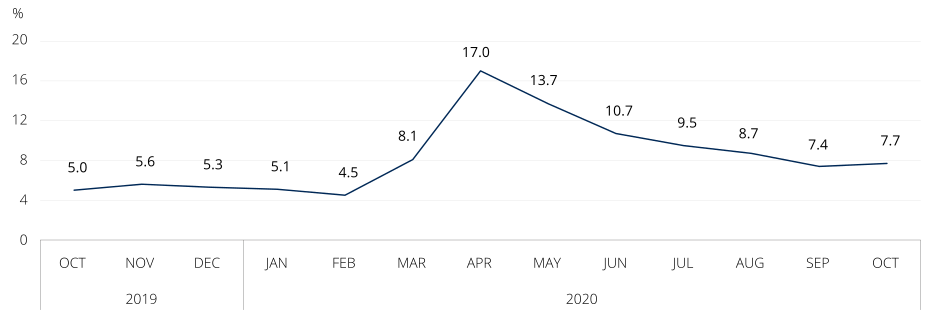
Montréal, November 6, 2020. – Employment in Québec was down by 12,900 (-0.3%) in October from September 2020. The unemployment rate rose 0.3 percentage points in October to 7.7%. These are the main highlights from Statistics Canada’s Labour Force Survey released today.
Employment increased by 694,000 in the last six months, which represents about 85% of the 820,500 jobs lost between February and April 2020.
In October, full-time employment grew (+22,000), while part-time employment declined (-35,200). Employment decreased in both the private sector (-9,700) and the public sector (-21,900), while self-employment rose by 18,700. The participation rate was down 0.1 points to 64.6%, the same level as in February 2020. The employment rate dropped 0.2 points to 59.7%.
Excluding accommodation and food services (-41,600) and information, culture and recreation (-11,400), which were affected by the tightening of sanitary measures due to several Québec regions becoming red zones, employment increased by 40,100 in other industries overall.
In Canada, in October, employment increased by 83,600 (+0.5%). The unemployment rate declined 0.1 points to 8.9%. The largest employment gains were recorded in British Columbia (+33,500), Ontario (+30,600), and Alberta (+23,400).
In the first ten months of 2020, employment in Québec decreased by 225,200 compared with the same period last year. Over this period, full-time employment fell by 115,600 and part-time employment by 109,600. Since the beginning of 2020, the unemployment rate in Québec has averaged 9.2% (Canada: 9.6%).
Changes in employment and trend-cycle data, Québec, October 2019 to October 2020
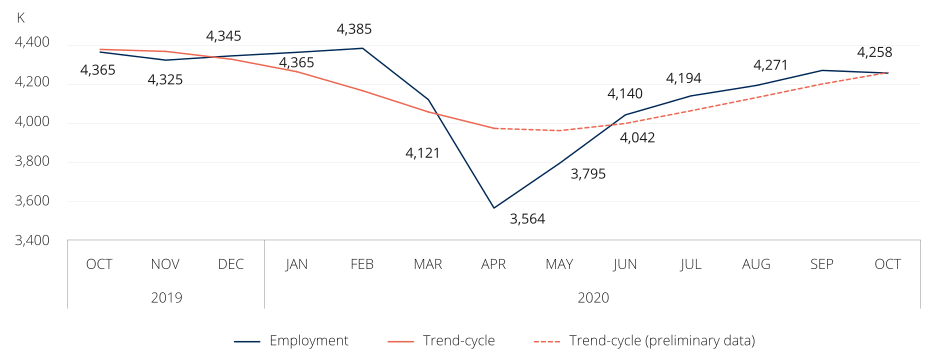
Note: Trend-cycle data are a smoothed version of seasonally-adjusted data where the effects of irregular movements have been reduced. They are helpful in analyzing long-term changes in the data. For more information: Statistics Canada, Trend-cycle estimates – Frequently asked questions.
Source: Statistics Canada, Labour Force Survey, 2020. Adapted by the Institut de la statistique du Québec.
Changes in the unemployment rate, Québec, October 2019 to October 2020
Source: Statistics Canada, Labour Force Survey, 2020. Adapted by the Institut de la statistique du Québec.
A word of caution regarding the effects of COVID-19 on LFS data
The effects of the COVID-19 crisis on the labour market in October must be interpreted with caution when analyzing Labour Force Survey (LFS) data.
The survey reference period for October is October 11 to 17. The correct categorization of individual labour force status according to the usual definitions of employment, unemployment1 and inactivity may have been more difficult in this edition of the survey, as has been the case since the beginning of the COVID-19 crisis. The COVID-19 section of the Institut de la statistique du Québec’s website provides analyses of the pandemic’s impact in Québec. It should also be noted that the monthly data are based on a sample and are therefore subject to a certain amount of variability.
1 The Labour Force Survey defines unemployed persons as those who, during the reference week: 1- were on temporary layoff with an expectation of recall and were available for work, or 2- were without work, had looked for work in the past four weeks, and were available for work, or 3- had a new job to start within four weeks, and were available for work.
The Institut de la statistique du Québec produces, analyzes and disseminates official, objective and quality statistical information on various aspects of Québec society. It is responsible for conducting all statistical surveys of general interest. The relevance of its work makes it a strategic ally for decision makers and all those wishing to learn more about Québec.