
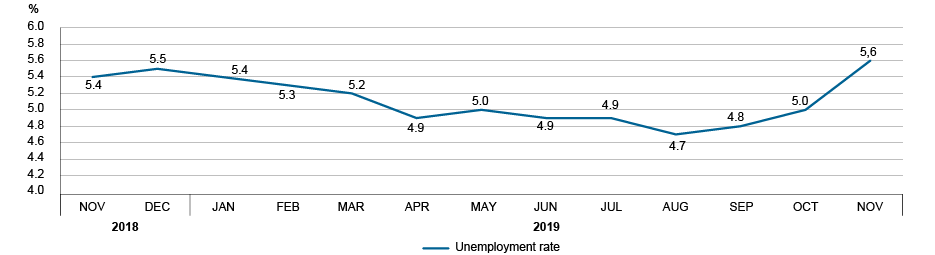
Montréal, December 6, 2019. – In November, employment decreased by 45,100 (-1.0%) in Québec compared with October 2019. The unemployment rate rose 0.6 points to 5.6%. These are the main findings of an analysis of the employment and labour force data released today by the Institut de la statistique du Québec, based on the results of Statistics Canada’s Labour Force Survey.1
Both full-time (-32,700) and part-time (-12,400) employment decreased. Employment declined by 29,600 in the private sector, 11,900 in the public sector and 3,600 among self-employed workers. The participation rate (-0.3 points) and the employment rate (-0.7 points) retreated to 64.7% and 61.1% respectively in November.
In Canada, employment was down (-71,200, -0.4%). The unemployment rate rose to 5.9% (+0.4 points). Québec (-45,100), Alberta (-18,200) and British Columbia (-18,200) recorded the largest drops in employment, while Ontario (+15,400) posted the strongest growth.
In the first 11 months of 2019, employment in Québec increased by 74,200 (+1.7%) compared with the same period in 2018. During this period, full-time and part-time employment increased by 56,400 and 17,800, respectively. Since the beginning of 2019, the unemployment rate in Québec has averaged 5.0% (5.7% in Canada).
Changes in employment and trend-cycle data, Québec, November 2018 to November 2019
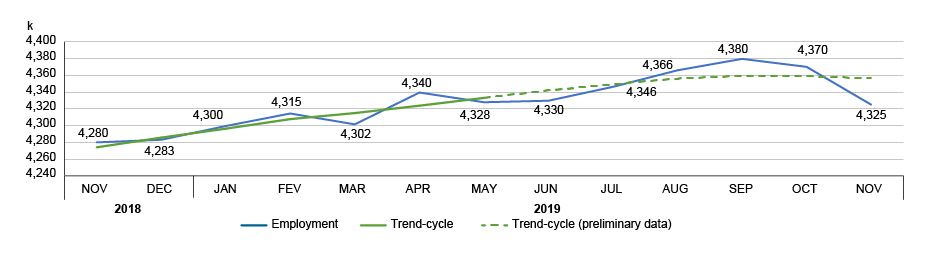
Note: Trend-cycle data are a smoothed version of seasonally adjusted data where the effects of irregular movements have been reduced. They are helpful in analyzing long-term changes in the data. A 13-period Dagum and Luati weighted moving average is applied systematically to each month of the seasonally adjusted series, except for the past six months, where asymmetric weighting is substituted for the Dagum and Luati averages. Data for the six most recent months (dashed line) are based on a preliminary estimation of the trend-cycle and may be revised when data for a new month are added. For more information: Trend-cycle estimates – Frequently asked questions. Fortier, Matthews and Gellatly. Statistics Canada.
Source: Statistics Canada, Labour Force Survey, 2019. Adapted by the Institut de la statistique du Québec.
Changes in the unemployment rate, Québec, November 2018 to November 2019
Source: Statistics Canada, Labour Force Survey, 2018. Adapted by the Institut de la statistique du Québec.
1. Every month, the Institut de la statistique du Québec publishes the Résultats de l’Enquête sur la population active pour le Québec based on data released by Statistics Canada. This document is available on the Institut’s website at 2 p.m. The monthly estimates taken from the Labour Force Survey are based on a sample and are thus subject to a greater variability than trends observed over longer periods of time, particularly when these estimates are broken down by subcategory such as sex, age, region or industry.
The Institut de la statistique du Québec produces, analyzes and disseminates official, objective and quality statistical information on various aspects of Québec society. It is responsible for conducting all statistical surveys of general interest. The relevance of its work makes it a strategic ally for decision makers and all those wishing to learn more about Québec.