
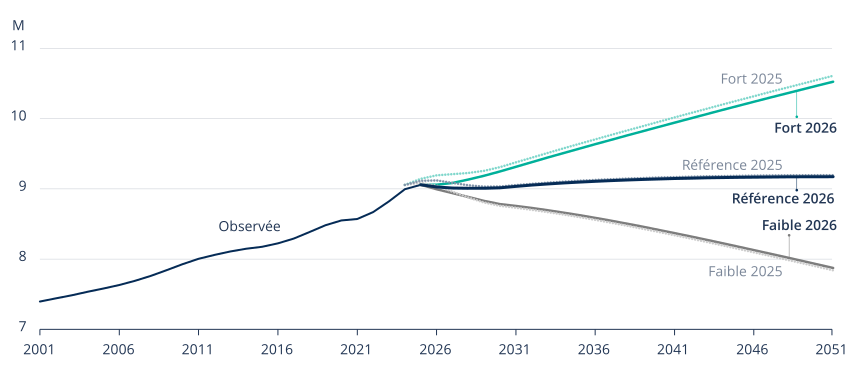
Québec City, July 9, 2026 – The Institut de la statistique du Québec released today its annual population projections update for Québec and its regions. It shows that the population of Québec could stabilize around 9.2 million over the next few decades. After an increase of nearly 500,000 over the last four years, the population should decline by about 50,000 (–0.6%) over the short term (2025 to 2029), mostly because of an expected reduction in temporary immigration.
The new projections take into account the most recent data on migration, fertility and mortality. The main trends projected nevertheless remain similar to those of last year.
Highlights of the three base scenarios are discussed in the publication Perspectives démographiques du Québec et de ses régions, mise à jour 2026].
Observed and projected population by scenario, Québec
Source
Institut de la statistique du Québec.
In addition to the base scenarios, other analytical scenarios are included to reflect the various possible ways the Québec population could evolve. These supplementary results are analyzed in Entrevoir le futur démographique du Québec : l’éclairage des scénarios prospectifs, in which more than 20 scenarios are compared from the perspective of population growth, demographic aging, and the balance between the labour force and the non-working population.
Capitale-Nationale region should see strongest growth
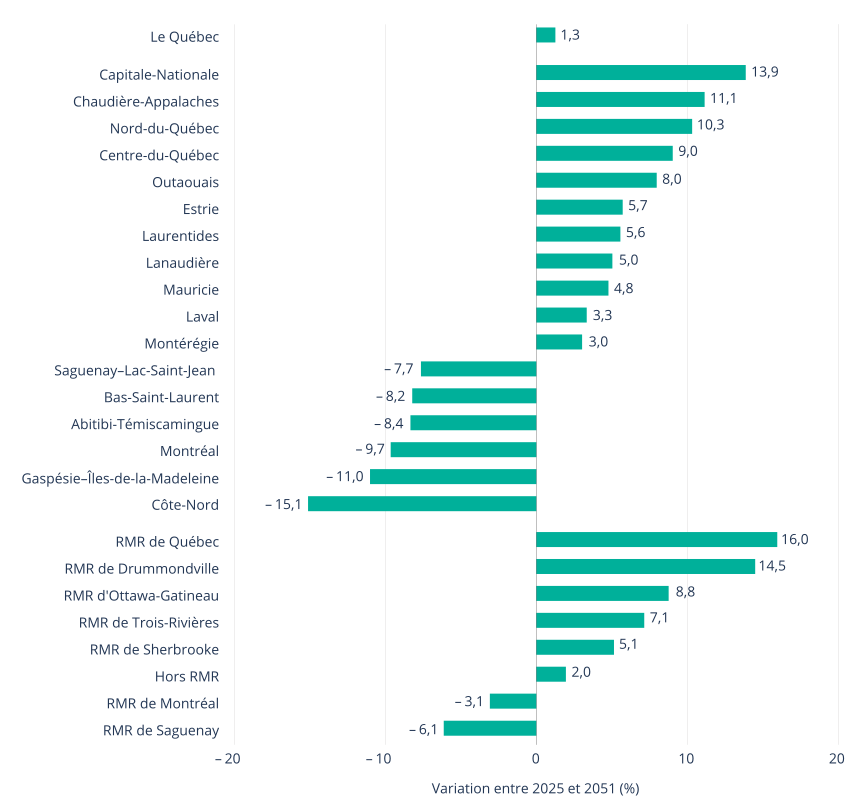
In the 2026 reference scenario, Capitale-Nationale remains the administrative region with the strongest growth projected between 2025 and 2051 (+14%), while the neighbouring region of Chaudière-Appalaches has the second-highest projected growth (+11%). At the other end of the spectrum are Côte-Nord and Gaspésie–Îles-de-la-Madeleine, with declines of –15% and –11% respectively.
Of the census metropolitan areas (CMAs), Québec City is expected to show the strongest growth (+16%), followed by Drummondville (+15%). Saguenay and Montréal are the only CMAs with a lower projected population in 2051 than in 2025 (–6% and –3% respectively).
Lower growth prospects for the Montréal Island
The decrease in the administrative region of Montréal (the island),— at -10% by 2051—will be more pronounced than in the Montréal CMA as a whole. The decline, which will be concentrated between now and 2030, is mainly due to the expected reduction in the number of temporary immigrants and the continued regionalization of immigration. By 2051, the population of the Montréal Island will be back to its 2016 level, that is, 1.96 million people, while the CMA’s outlying areas will continue to grow until they reach 2.5 million.
Projected change in population according to 2026 reference scenario, Québec and regions, 2025–2051
Source
Institut de la statistique du Québec.
Population should decrease by 2029, but not housing needs
Projections on the number of private households and people in collective dwellings have also been updated. The new reference scenario shows a –0.6% population decline for the province between 2025 and 2029, as well as a +0.7% increase in demographic housing needs over the same period. This can be attributed to changes in the age structure of the population and differing housing needs by age, which should lead to strong growth in housing needs for seniors, especially for people living in collective dwellings.
Key takeaway: Projections are an exercise in possibilities
Population projections are models of future demographic trends, derived from assumptions about fertility, mortality and migration. The reference scenario shows how the population could change if current trends and directions continue. Population projections are therefore not forecasts or predictions. They provide a neutral, objective perspective on the various possible ways demographics could evolve in Québec.
View projections by age group and scenario:
- Interactive graphs and detailed data – Québec population
- Interactive graphs and detailed data – Population of regions
- Detailed data – Private households and collective dwellings
Projections by RCM and municipality based on these scenarios will also be released in the coming months. Subscribe to email notifications on the Institut de la statistique du Québec’s website to be informed of upcoming releases on population projections
The Institut de la statistique du Québec is the public body responsible for providing reliable, objective statistical information about Québec society. The relevance of its work makes it a strategic ally for decision makers and an essential source of information for all those wishing to learn more about Québec.