
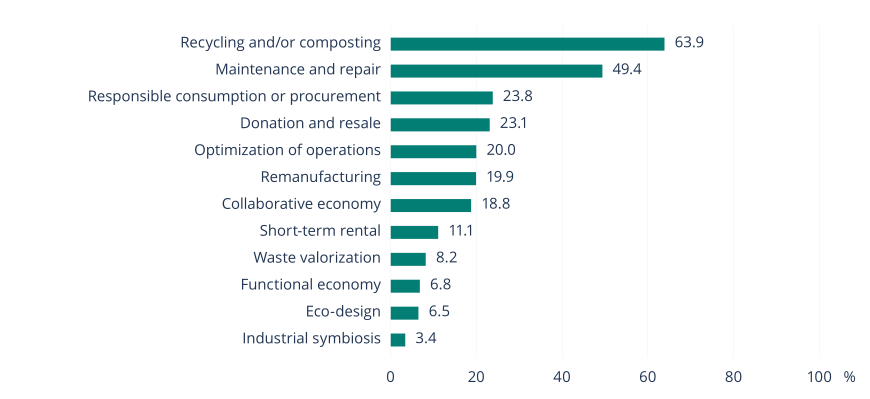
Québec, August 28, 2025. – In Québec, 82% of businesses reported having implemented at least one circular economy practice in 2022. This proportion drops to 69% when recycling/composting is excluded. Recycling/composting was the most common circular economy practice among Québec businesses, as 64% of them implemented it in 2022, followed by maintenance and repair (49%).
Proportion of businesses1 that implemented a circular economy practice, by circular economy practice, Québec, 2022
1. Businesses with 5 or more employees.
Note
Some results may not be statistically different from one another. See the publication for more details.
Source
Institut de la statistique du Québec.
In general, business size and sales revenue have little impact on the propensity of businesses to implement circular economy practices.
Circular economy practices focused on reducing the amount of materials used at the source are implemented less often than others, as are practices aimed at intensifying the use of materials (for example, rental). Conversely, the most commonly used practices are those aimed at extending the lifespan or disposing of materials, such as maintenance and repair or recycling.
Circular economy practices more widespread in certain industry sectors
The industry sectors that stand out for their use of circular economy practices include the arts, entertainment and recreation sector and the primary sectors (agriculture, forestry, fishing, natural resources extraction), with a few exceptions.
Businesses in the accommodation and food services, bio-food, and transportation and warehousing sectors are less likely than businesses overall to have used circular economy practices.
To learn more
L’économie circulaire chez les entreprises au Québec (PDF, 1,06 Mo)
L’économie circulaire selon les secteurs d’activités au Québec (PDF, 2,34 Mo)
The circular economy aims to maximize the use of resources already present in the economy rather than extracting virgin materials. In the circular economy, residual materials are a potential material resource. This is in contrast with the linear economy, which is based on extracting and processing virgin materials which will ultimately be disposed of.
Examples of circular economy practices include recycling and composting, equipment rental, process optimization, and product refurbishing.
The Institut de la statistique du Québec produces, analyzes and disseminates official, objective and quality statistical information on various aspects of Québec society. It is responsible for conducting all statistical surveys of general interest. The relevance of its work makes it a strategic ally for decision makers and an essential source of information for all those wishing to learn more about Québec.