
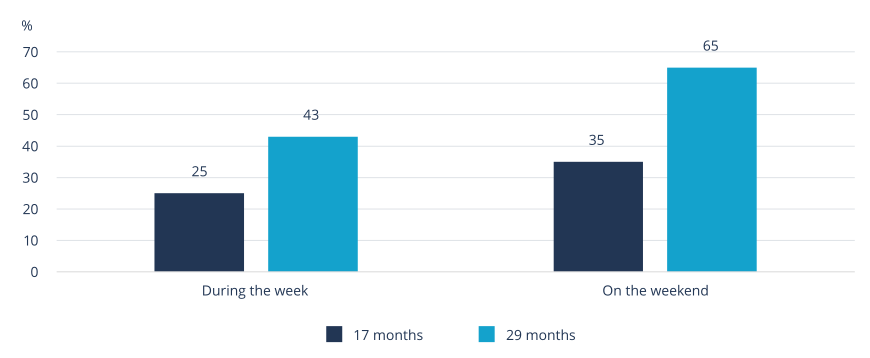
Montréal, December 3, 2025. – At two and a half years old, nearly 43% of toddlers are getting at least one hour of screen time per day on average during the week. This proportion reaches 65% on the weekend. This is an increase compared with the daily screen time observed a year earlier. When the children were one and a half years old, the share of toddlers who spent at least one hour per day on screens was 25% during the week and 35% on the weekend.
This information comes from a publication by the Institut de la statistique du Québec entitled Les écrans chez les tout-petits : une évolution rapide des premières habitudes numériques based on the longitudinal study Growing Up in Québec. This study is following more than 4,000 children born in Québec in 2020–2021 until they reach adulthood.
Proportion of children1 who watch or use screens at least one hour per day during the week and on the weekend at about 17 and 29 months, Québec, 2022–2024
Notes
1. Children born in Québec in 2020–2021.
Source
Institut de la statistique du Québec, Québec Longitudinal Study of Child Development, 2nd edition.
Children aged two and a half years living in low-income households are more likely than others to be getting at least two hours of screen time per day, both during the week (27% vs. 10%) and on the weekend (42% vs. 29%).
Increase in daily viewing of children’s content
At two and a half years, nearly 59% of toddlers watch children’s shows, videos or movies at least once a day. A year earlier, at the age of about one and a half, this proportion was 39%.
The proportion of toddlers who use screens daily to listen to stories, songs or nursery rhymes also rose between the age of one and a half (27%) and two and a half (35%).
Use of screens during meals and before bedtime is increasing
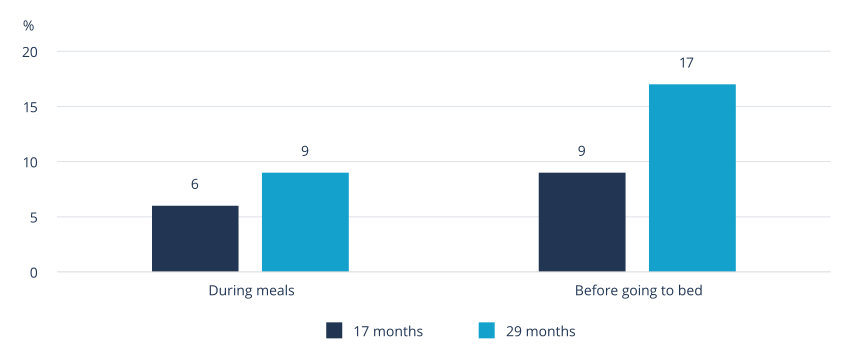
At the age of two and a half, about 9% of toddlers watch TV shows, videos or movies daily during meals, and slightly under 1 in 5 toddlers (17%) do so daily before going to bed. This was less common a year earlier, at the age of one and a half (during meals: 6%; before going to bed: 9%).
Proportion of children1 who watch TV shows, videos or movies daily during meals or before going to bed at about 17 and 29 months, Québec, 2022–2024
Notes
1. Children born in Québec in 2020–2021.
Source
Institut de la statistique du Québec, Québec Longitudinal Study of Child Development, 2nd edition.
About the study
The Growing Up in Québec study was started to fulfill a need for knowledge about the development of children born in Québec. This second edition of the Québec Longitudinal Study of Child Development is carried out by the Institut de la statistique du Québec in collaboration with various partners. The study is funded by the Lucie and André Chagnon Foundation, the Ministère de la Famille, the Ministère de la Santé et des Services sociaux, the Ministère de l’Éducation, the Ministère de l’Emploi et de la Solidarité sociale, the Conseil de gestion de l’assurance parentale, and the Institut de la statistique du Québec.
The children covered by the study were born in 2020–2021 to mothers living in Québec. The initial sample included 4,703 children, and data about them will be collected every year from the age of 5 months to about 8 years. Afterwards, data should be collected every two years, as well as at certain key moments. The third data collection took place from May 2023 to March 2024 when the children were about 29 months old.
The Institut de la statistique du Québec produces, analyzes and disseminates official, objective and quality statistical information on various aspects of Québec society. It is responsible for conducting all statistical surveys of general interest. The relevance of its work makes it a strategic ally for decision makers and all those wishing to learn more about Québec.