
Montréal, November 17, 2025. – Nearly 83% of children aged two and a half years are active every day when playing at home. They run, jump, climb, play ball, ride a tricycle... This was revealed in a portrait published by the Institut de la statistique du Québec entitled Le jeu chez les tout-petits d’environ deux ans et demi. This document is based on the longitudinal study Growing Up in Québec, which is following more than 4,000 children born in Québec in 2020–2021 until they reach adulthood.
Outdoor play varies depending on the season
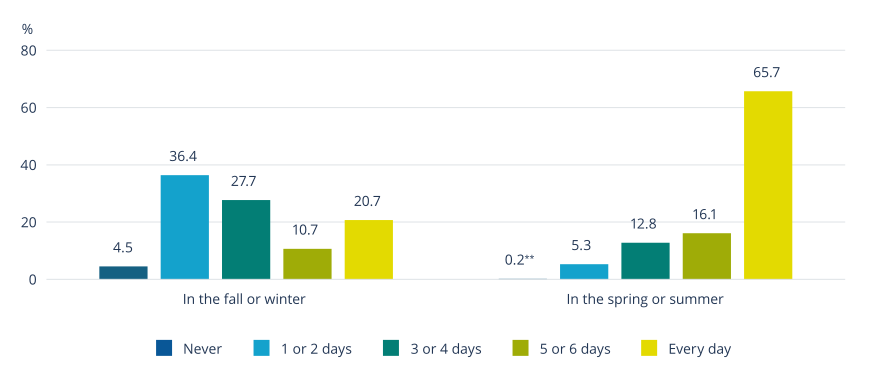
Outdoor play is more frequent in the spring and summer. Two in three toddlers (66%) play outside every day in a typical spring or summer week, versus about one in five (21%) in the fall and winter.
Number of days per week that children play outside in a typical week,1 children aged about 29 months,2 Québec, 2023–2024
Notes
** Coefficient of variation greater than 25%; imprecise estimate provided for information purposes only.
1. Excludes time spent in childcare.
2. Born in Québec in 2020–2021.
Source
Institut de la statistique du Québec, Québec Longitudinal Study of Child Development, 2nd edition.
Play at age two and a half: differences between girls and boys
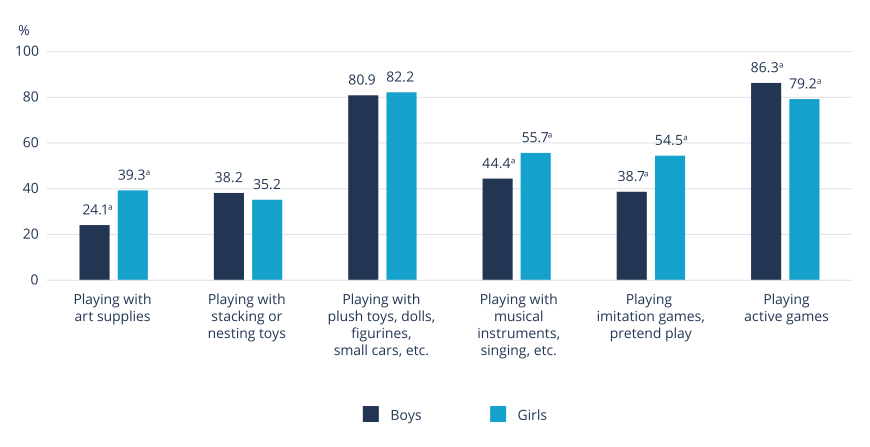
A larger proportion of boys than girls engage in active play every day during a typical week at home (86% vs. 79%).
On the other hand, girls are more likely than boys to play with art supplies, to play a musical instrument or sing, or to play imitation games (dressing up, role-playing games, etc.) on a daily basis.
Proportion of children who engage in different types of play at home on a daily basis by sex, children aged about 29 months,1 Québec, 2023–2024
Notes
a For a given type of play, this expresses a significant difference between boys and girls at the 0.05 threshold.
1. Born in Québec in 2020–2021.
Source
Institut de la statistique du Québec, Québec Longitudinal Study of Child Development, 2nd edition.
Participation in supervised physical activity is uneven among young children
Slightly less than a third (30%) of toddlers aged about two and a half years participated in a sport or physical activity with a coach or instructor (such as swimming, dance, gymnastics, or soccer lessons) in the 12 months before the survey.
This proportion is lower among toddlers:
- Who are living with at least two other children (17%)
- Whose two parents (or single parent) were born outside Canada (20%)
- Who are living in low-income households (10%)
4 in 10 toddlers are active every day with their parents
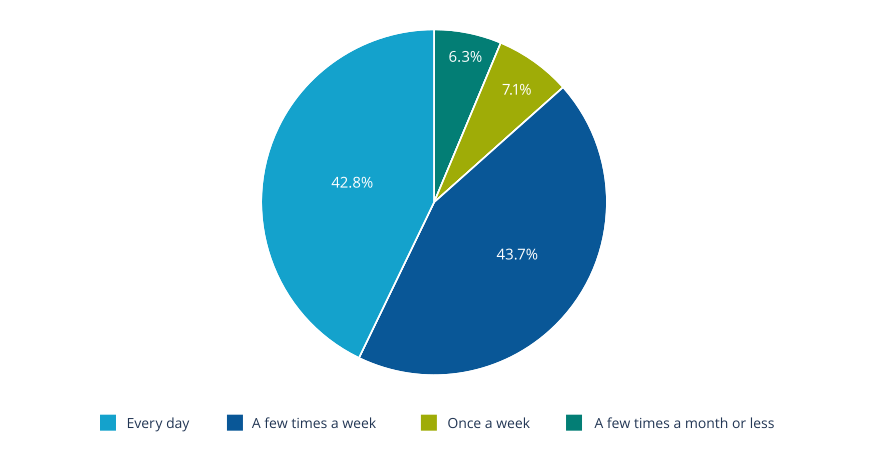
About 43% of toddlers aged two and a half years engage in physical activity—such as taking a walk or playing outside—with an adult on a daily basis.
Frequency with which an adult in the home engages in physical activity with their child, children aged about 29 months,1 Québec, 2023–2024
Note
1. Born in Québec in 2020–2021.
Source
Institut de la statistique du Québec, Québec Longitudinal Study of Child Development, 2nd edition.
About the study
The Growing Up in Québec study was started to fulfill a need for knowledge about the development of children born in Québec. This second edition of the Québec Longitudinal Study of Child Development is carried out by the Institut de la statistique du Québec in collaboration with various partners. The study is funded by the Lucie and André Chagnon Foundation, the Ministère de la Famille, the Ministère de la Santé et des Services sociaux, the Ministère de l’Éducation, the Ministère de l’Emploi et de la Solidarité sociale, the Conseil de gestion de l’assurance parentale, and the Institut de la statistique du Québec.
The children covered by the study were born in 2020–2021 to mothers living in Québec. The initial sample included 4,703 children, and data about them will be collected every year from the age of 5 months to about 8 years. Afterwards, data should be collected every two years, as well as at certain key moments. The third data collection took place from May 2023 to March 2024 when the children were about 29 months old.
The Institut de la statistique du Québec produces, analyzes and disseminates official, objective and quality statistical information on various aspects of Québec society. It is responsible for conducting all statistical surveys of general interest. The relevance of its work makes it a strategic ally for decision makers and an essential source of information for all those wishing to learn more about Québec.